
Most visitors to this corner of Sardinia come for the coves — Cala Goloritzè, Cala Mariolu, Cala Luna — and drive straight through Baunei on the way to a trailhead. That’s worth slowing down for. Baunei itself, and the Golgo plateau above it, are among the most distinctive inland landscapes on this coast: a mountain village with a working pastoral history, and a basalt-and-limestone upland scattered with sinkholes, stone chapels, and shepherds’ huts. This guide covers Baunei and Golgo on their own terms — for the coastal hikes that start from here, see our guides to hiking to Cala Goloritzè and Cala Luna.
Why Travelers Should Stop
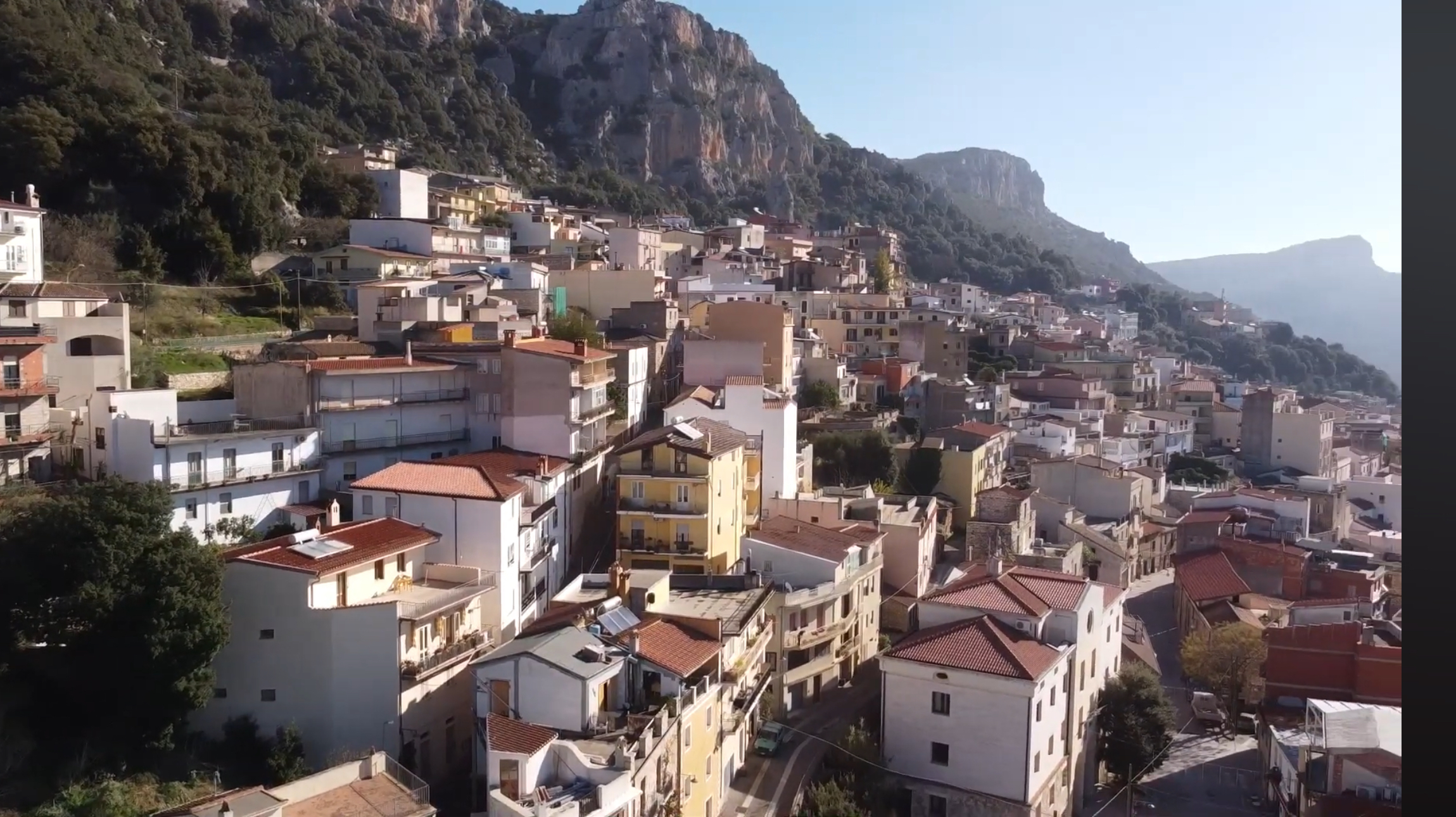
Baunei sits at approximately 480 meters above sea level, built along a limestone mountainside. In 1834, the Sardinian abbot and scholar Vittorio Angius described its isolated mountain position and recorded the local tradition that the settlement originated around the tenth or eleventh century with a goatherd seeking refuge in this defensible landscape. What makes Baunei worth a deliberate stop, rather than a drive-through, is the combination on offer nowhere else on this coast: a genuine mountain village a few minutes from a plateau riddled with karst caves and Nuragic history, itself a short drive from some of the most photographed beaches in Sardinia.
Between the Mountains and the Coast
Baunei’s geography is the reason it looks and feels the way it does. The village sits on a limestone ridge, with the basalt-topped Golgo plateau rising behind it to the west, and the Gulf of Orosei’s cliffs dropping to the sea below and to the east. This isn’t incidental scenery — it shaped a pastoral economy built around the plateau’s grazing land, while Santa Maria Navarrese developed as Baunei’s coastal settlement.

A Pastoral Village, Still
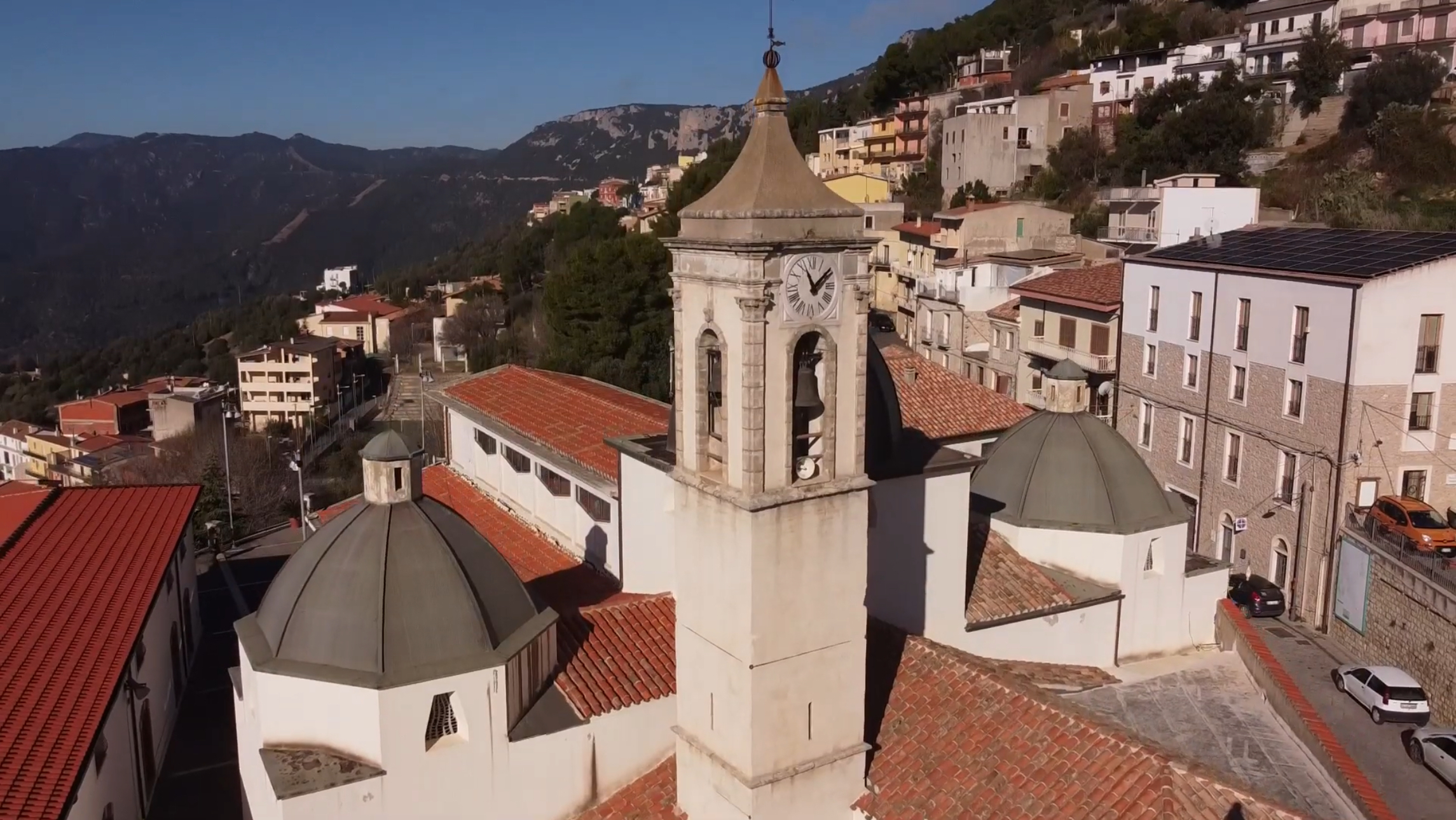
Baunei’s identity is bound up with sheep and goat herding in a way that isn’t just historical color — it’s still visible today. Shepherds from Ogliastra and Barbagia have long gathered in Baunei’s streets, part of a pastoral tradition that has shaped the village for centuries. Walking the historic center today, that layered history shows in the architecture: steep winding alleys, old stone houses, and the domes of the Church of San Nicola at the center of the village.
Scenic Viewpoints and Walking the Village
Baunei’s position on the ridge means views open up unexpectedly as you move through it — down toward the coast in one direction, up toward the Golgo plateau in the other. The road up toward Golgo, a series of hairpin bends climbing above the village, has its own panoramic viewpoints as it gains altitude, stretching from the Gennargentu mountains to the Gulf of Arbatax. A short detour off that road leads to the Belvedere de Santu Franciscu, a panoramic terrace with an overhanging view back down onto the village — one of the better vantage points for Baunei’s position on the ridge as a whole.
The Golgo Plateau
Golgo is a genuinely strange landscape by Sardinian standards: a plateau capped in dark, Pleistocene-era basalt, sitting at roughly 630 meters, ringed by the paler limestone ridges typical of this part of the island. This is the plateau every hiker heading to Cala Goloritzè crosses at the start of their walk, but it’s a destination in its own right, with a concentration of historical, geological, and archaeological sites within a few square kilometers.
San Pietro Church
Near the heart of the plateau stands the small whitewashed rural Church of San Pietro, sitting quietly amid Mediterranean scrub. According to local tradition and the official Baunei tourism authority, the church was built between the seventeenth and eighteenth centuries through donations from Golgo’s herders. Local legend also holds that St. Peter sealed a dragon-like serpent inside the nearby Su Sterru chasm. The church’s annual festival is held on the last Sunday in June, with pilgrims traditionally lodging in “us istaulus,” the stone quarters built around the church for that purpose. Outside festival time, it’s a peaceful, low-key stop worth a few quiet minutes.

The Anthropomorphic Bethel
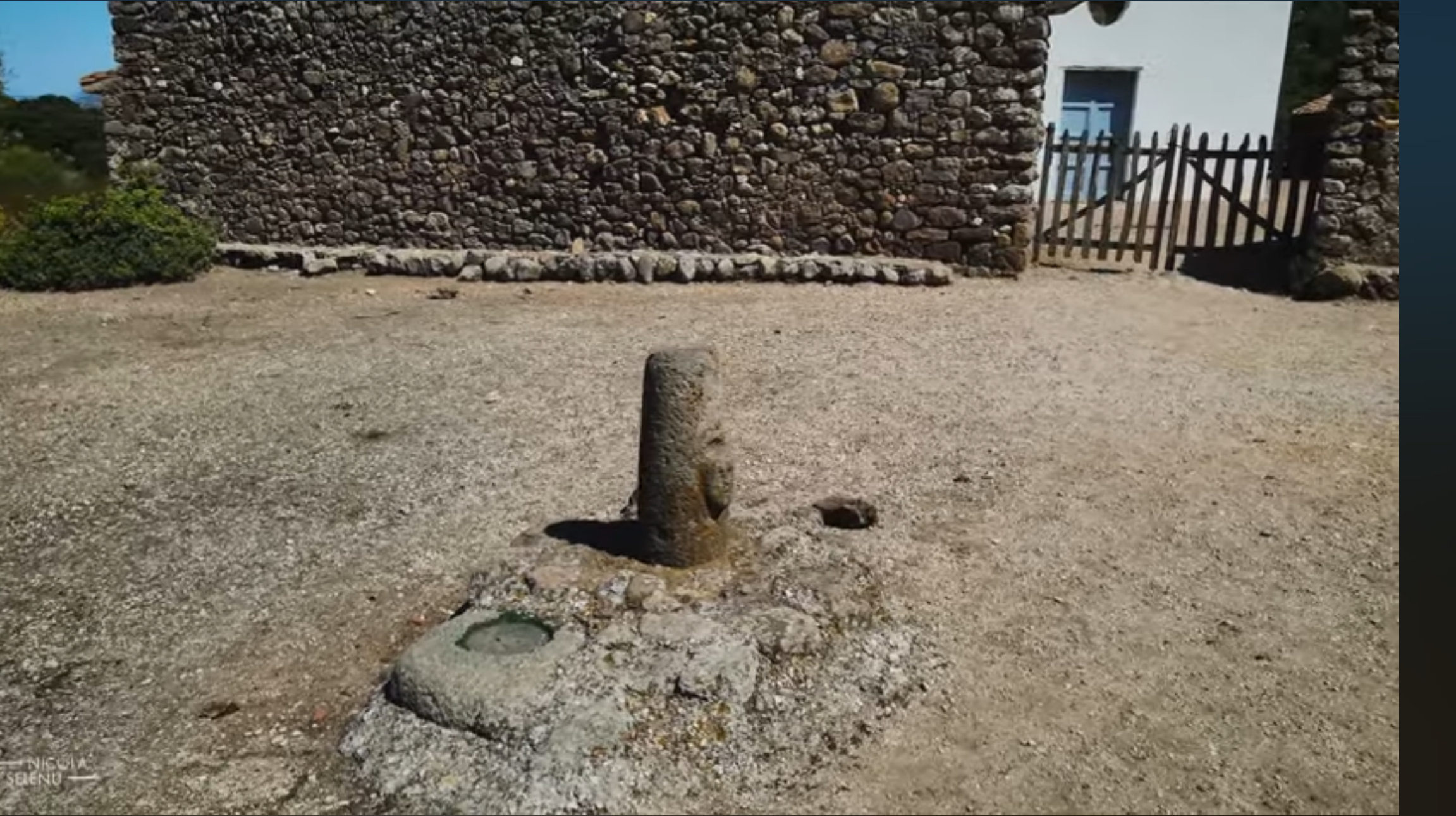
Near the entrance to San Pietro stands one of Golgo’s most important archaeological objects: an anthropomorphic bethel from the Nuragic era, a basalt monument carved with a human face. It’s easy to walk past without noticing, but it’s worth a deliberate look — a small, direct trace of the plateau’s use going back millennia before the church, the festival, or any of the tourist infrastructure that now surrounds it.
Pinnettos: The Traditional Stone Sheepfolds
Scattered across the plateau are pinnettos — traditional conical stone-and-branch shepherds’ huts, built without mortar in a style that goes back generations. These aren’t museum reconstructions; the building tradition grew directly out of the practical needs of shepherds working this exposed, waterless terrain, and some structures on the plateau are still used or maintained in a similar spirit today. They’re one of the clearest physical traces of Golgo’s working pastoral history.
Su Sterru
Su Sterru is the plateau’s best-known feature: a sheer karst sinkhole, described by the official Baunei tourism authority as one of Europe’s deepest single-drop karst chasms, at approximately 270 meters. Protected as a Natural Monument since 1993, it held a mysterious place in local imagination for centuries — early topographic maps mistakenly labeled it the crater of an extinct volcano, and it wasn’t fully explored and understood as a karst sinkhole until 1957. Visitors observe the chasm only from the protected surface area at the rim; there is no descent for casual visitors, and the edge should be treated with real caution regardless of any barrier in place.

As Piscinas and Other Historic Features
As Piscinas (“the pools”) are natural basalt basins on the plateau where rainwater stagnates year-round. According to the official Baunei tourism authority, scholars believe their shape was altered during the Nuragic period, possibly as part of a metalworking process. In more recent centuries, the pools became an important water source for herders and their livestock in a landscape otherwise largely without springs. Golgo’s broader archaeological record includes significant Nuragic-era finds, some of which are now held in Cagliari’s archaeological museum, underlining that this landscape has been continuously used and valued for millennia, not just discovered by modern tourism.
The Animals of Golgo
According to the official Baunei tourism authority, free-ranging donkeys, cattle, and pigs are characteristic of the Golgo plateau, moving largely unfenced as a living extension of the area’s pastoral character. Sightings are common enough that many visitor accounts mention them, but these are wild-ranging or semi-wild animals, not a guaranteed encounter. Keep a respectful distance and don’t feed them.

Driving from Baunei to Golgo
The road to Golgo branches off from Via Orientale Sarda near the Church of San Nicola in Baunei, climbing via hairpin bends up the rocky ridge above the village to around 630 meters, where the views open up dramatically. From there, the paved road — locally known as the “Bia Maore,” or main road — continues on a gentler grade into the heart of the plateau.
Paved and Unpaved Road Conditions
According to the official Baunei tourism authority, the principal paved road (the “Bia Maore”) reaches the central Golgo area and ends not far from San Pietro church, Su Sterru, and As Piscinas — covering the plateau’s main sites. From there, the route continuing alongside As Piscinas toward the Su Porteddu car park and the start of the Cala Goloritzè trail is unpaved. Don’t assume the trailhead itself is reached entirely by paved road — the final stretch is a dirt track. Other dirt tracks also branch off the main paved route to further points on the plateau, including a panoramic terrace and an area used by local shepherds.
Affiliate disclosure: Some links in this guide are affiliate links. If you make a qualifying purchase through them, SardiniaSardegna may earn a commission at no additional cost to you. Our recommendations are based on their relevance to the trip.
Renting a Car for Baunei and Golgo
A rental car gives you the flexibility to explore Baunei, the Golgo plateau, and nearby coastal towns without depending on limited rural transport connections. Olbia and Cagliari are both possible arrival airports for this part of Sardinia. Compare vehicles and pickup options before booking, and check your rental agreement carefully before driving on unpaved roads.
Parking and Navigation
Designated parking operates near the Su Porteddu restaurant and trail entrance under the current Cala Goloritzè access system, though current rules and any associated fees should be checked before your visit rather than assumed. We don’t have confirmed details on parking arrangements at the other individual plateau sites (San Pietro, Su Sterru, As Piscinas) beyond the general presence of pull-offs along the main road — check locally on arrival. Signposting on the plateau is present but not dense, so a downloaded map or GPS route is worth having, particularly if you’re exploring beyond the paved main road.
Mobile Data for Exploring Inland Sardinia
Mobile data can help with navigation, checking local information, and contacting accommodation providers while traveling between Baunei and the coast. If your existing phone plan doesn’t include suitable roaming in Italy, an Italy eSIM is one option. Check that your phone is unlocked and eSIM-compatible before purchasing, and download offline maps as mobile coverage can be inconsistent in remote areas.
Seasonal Services and Facilities
Golgo has had a tourism-oriented presence since the 1970s, including a long-established restaurant built in the traditional style of the plateau’s stone shepherds’ huts. Treat any given business’s hours or continued operation as something to confirm rather than assume, especially outside peak season — this is genuinely rural terrain, and services here can change from year to year.
Where to Eat
Both Baunei village and the Golgo plateau have working restaurants, including establishments with deep roots in the area’s pastoral traditions. Rather than naming specific businesses here — hours and ownership can shift — check current listings and recent reviews before you go, and ask locally once you arrive; word of mouth is often the most current source in an area this small.
Baunei or Santa Maria Navarrese: Where to Stay
Baunei village and its coastal counterpart, Santa Maria Navarrese, offer genuinely different overnight experiences. Baunei gives you the mountain village atmosphere and proximity to the Golgo plateau, but it’s a drive from the sea with fewer beach-adjacent amenities. Santa Maria Navarrese sits directly on the coast, with easier access to swimming and boat excursions, at the cost of a short additional drive up to Golgo each time. Neither is objectively better — travelers prioritizing the plateau and the Cala Goloritzè hike may prefer Baunei itself; those who want beach time as their daily default are often better served by Santa Maria Navarrese.
Compare Accommodation in Santa Maria Navarrese
If you’d rather stay beside the sea and visit Baunei and Golgo as a day trip, Santa Maria Navarrese is a practical coastal base. Compare accommodation options and locations before deciding where to stay.
How Long You Realistically Need
A half day is enough to walk Baunei’s historic center, take in a viewpoint or two, and see the main Golgo sites (San Pietro, Su Sterru, As Piscinas) without rushing. A full day allows a more unhurried pace, a meal on the plateau, and time to explore beyond the paved main road. If combining Golgo with the Cala Goloritzè hike, plan for a full day at minimum.
Combining Golgo with Cala Goloritzè
Golgo is the starting point for the Cala Goloritzè hike, and many visitors naturally combine the two — seeing Su Sterru, San Pietro, and As Piscinas either before setting out or after returning from the beach. If you’re planning this, budget realistically: the hike alone is a half-day commitment or more once you include the strenuous return climb, so treat the plateau’s other sights as a shorter add-on before or after, not something to fit into the middle of the hike itself. Full details on timing, difficulty, and reservations are in our Cala Goloritzè hiking guide.
Suitability for Families and Limited Mobility
Baunei village and the paved sections of the Golgo plateau are considerably more accessible than the coastal hikes covered elsewhere on this site. Walking Baunei’s center involves some steep, uneven lanes, but nothing comparable to a mountain trail. The central Golgo sights reachable by paved road — San Pietro, the Su Sterru viewing area, As Piscinas — require much less walking than the coastal hikes, making this a realistic option for travelers who can’t or don’t want to attempt the Cala Goloritzè hike. That said, surfaces, distances from parking, and accessibility can vary between sites and may include rough or uneven ground, so travelers with significant mobility limitations should check current conditions rather than assume an easy walk throughout.
What to Bring
- Comfortable walking shoes — Baunei’s lanes and Golgo’s paths are uneven, even where they’re not strenuous.
- Water — the plateau has little shade and no guaranteed water sources outside any open business.
- Sun protection — Golgo is exposed, with limited natural shade across most of the plateau.
- A map or downloaded route — signposting on the plateau is present but sparse in places.
- Cash — useful for any open rural businesses, which may not all take cards.
Responsible Behavior on the Plateau
Golgo is working agricultural land as much as it is a tourist destination, and both the animals and the land deserve the same care you’d bring to any protected natural or archaeological site. Keep a respectful distance from livestock and free-roaming animals, and don’t feed them. Stay on marked paths and respect any fencing or signage around Su Sterru and other sensitive sites — these exist for real safety and conservation reasons. Treat pinnettos, the church, and any archaeological features as living heritage rather than photo props: don’t climb on structures or remove stones, and pack out anything you bring in.
Who This Area Suits
Baunei and Golgo suit travelers who want Sardinia’s history and landscape beyond the coastline — anyone curious about the pastoral culture that shaped this region, or who wants a genuine change of pace from beach days. It pairs easily with a Cala Goloritzè hike, but also stands on its own for travelers with limited mobility or those simply looking for a quieter day than a boat excursion or a long hike offers. It’s a poor fit only for travelers who want a fast, single-purpose stop — Golgo rewards unhurried time more than a rushed checklist visit.
Half Day, Full Day, or Overnight?
For most travelers already based in Cala Gonone or elsewhere on the East Coast, a half or full day trip to Baunei and Golgo is the realistic choice, pairing naturally with our East Coast & Ogliastra destination page and Gulf of Orosei guide. An overnight stay in Baunei or Santa Maria Navarrese is worth considering if you want a full day on the Cala Goloritzè hike, an unhurried morning on the plateau, or simply prefer this quieter inland base to the busier resort towns farther north.